
Authoritarianism without authority
Hannah Arendt offers us subtle but important shifts in our vocabulary


1.
I’ve mentioned a couple of times that I have a couple of new books coming out in 2026—The Accessorized Bible with Yale and The Covert Magisterium with Bloomsbury (I’ll keep you posted). The 20th century philosopher Hannah Arendt plays a role in both of them. I find that I am drawing on her thought more and more as I dig deeper into my own projects.
Arendt came to mind recently as I was doomscrolling around YouTube. I happened upon this video from the channel, “Parkrose Permaculture,” about the differences between “authoritarian” and “non-coercive” parenting. The video is a little over six minutes long, so it’s worth it to take a look at it for yourself:
Now, I think there is a lot of useful analysis here. First of all, she’s drawing important parallels between tactics of force-based, coercive parenting and the susceptibility of those who participate in those relationships toward fascism and “strong man” leadership later in life. She cites Jesus and John Wayne by Kristen Kobes Du Mez as one example that talks about this (and it’s an excellent one). I would add to that For Your Own Good: Hidden Cruelty in Child Rearing and the Roots of Violence by Alice Miller, which (as the title suggests) traces similar avenues of thought, but the context of her analysis is the set of conditions that gave rise to Nazism in Germany.
The host of Parkrose Permaculture also notes the Evangelical practice of “breaking the child’s will,” which she describes as a tactic to render the child pliant and more available to parental control. She suggests that this is designed to downplay or eradicate the child’s independence of thought. “Now I recognize how primed [my peers] were to be indoctrinated into [the alt-right] dynamic,” she says in the video, “To never trust your own instincts … and obey.”
Her conclusion, in sum, is that this form of coercive parenting has set up an entire generation (and possibly more) of conservatives and Evangelicals to be ready to submit to a “strong man” leader, such as Donald Trump, without question.
2.
The host of Parkrose Permaculture describes this coercive style of parenting as “authoritarian” parenting. Now, I think I understand what she means when she uses this term. I think she means that “coercion” is not just an occasional tactic, but rather it’s a thoroughgoing policy choice. It means (I think) that the entire relationship between parent and child is built on intimidation, and even on violence.
It’s likely that many of us have encountered this use of the term “authoritarian” before. The difficulty is that “authoritarian” sounds very much like “authority,” and this similarity can cause us some deep confusion. So I’m going to try here to tease out the important distinctions between these two terms. In what follows, I’m going to make the case that we would benefit from tweaking our language around authority, and even around authoritarianism, and that doing that can help us focus better on the right set of problems and concerns. The path to this re-evaluation takes us through the work of Hannah Arendt.
In The Covert Magisterium, I make the suggestion that—for better or worse, and usually worse—we are all actually authoritarians, especially if we identify as Christians. For better or worse (and usually worse), almost all forms of Christianity make authoritarian claims. Many forms of Christianity dare to suggest that there is no realm of life, public or private, that is beyond the jurisdiction of Christ. In a secular political situation, such as we have in America, this causes everyone a good number of headaches in the public sphere.
But in making this assertion, I want to distance myself from the claim that this means that Christianity is necessarily allied with coercion and violence. It certainly is the case that many forms of Christianity are comfortable with coercion and violence. However, these are not essential aspects of Christian practice, but in most cases, authority is.
3.
Let me take a step back and explain what I mean. Imagine that your home experiences a power spike in your neighborhood, and as a result, some of your wiring shorted out. Now, if the damage can be repaired easily (say, by flipping a breaker), then you or anyone else would be perfectly fine to do it.
But let’s say that it’s not so simple. Let’s say instead that the repairs require getting into the guts of breaker box itself, or the wiring in the wall. Maybe you’d feel comfortable tackling that (some folks, like my father in law, are handy that way), but it quickly becomes a task that not just anybody could (or should) do. In this case, you’d probably want to call in an electrician to do the repairs.
Now what differentiates an electrician from a regular person off the street? That’s a complex question. In a culture such as ours, the individual may be credentialed, or bonded. They may belong to a guild or a union. They might belong to a firm, or run a sole proprietorship, whose reputation can be checked with organizations like the Better Business Bureau. In each of these combinations, the individual walks into your home bearing certain markers of expertise. That is to say, at least in matters having to do with home electrical wiring, this individual is considered an authority.
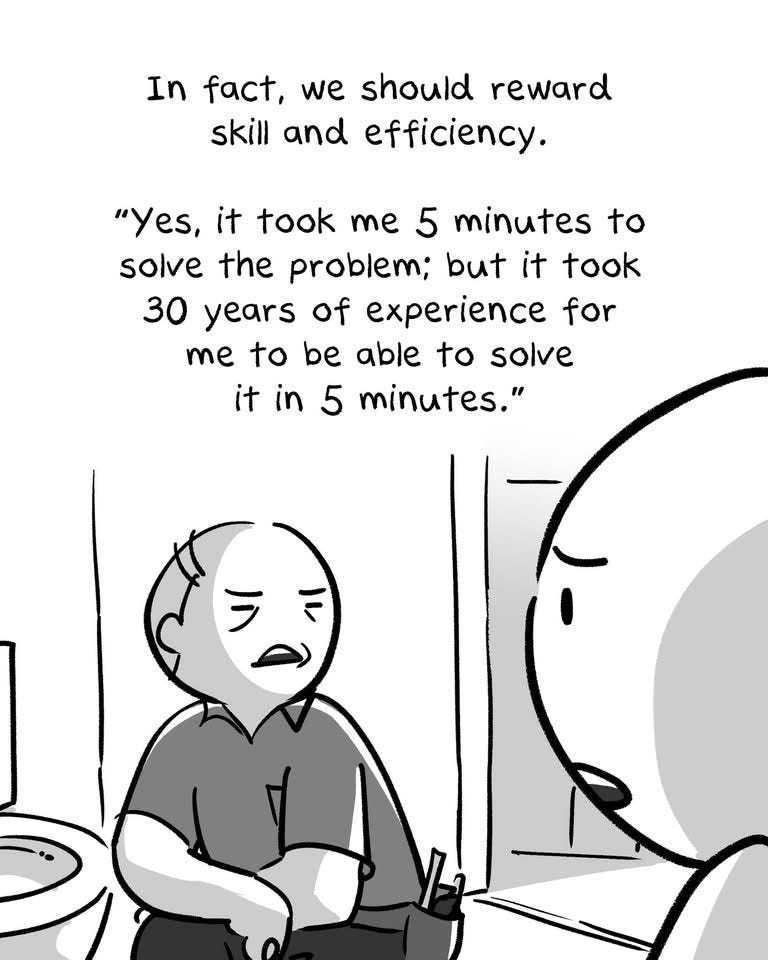
In her book Between Past and Future, Hannah Arendt took up this matter in a chapter titled, “What is Authority?” In the chapter, she makes some distinctions that are important to our understanding. First, the electrician who comes into your home does not coerce you to use her services. There is no violence or threat of violence involved in her establishing herself as an expert.
Moreover, the electrician does not enter into a debate with you, or lecture you, in order to convince you by reason that they are, in fact, an electrician and an expert. Instead, the electrician who enters your home does so by means of a third space, that is neither coercion or convincing. They enter instead as an authority.
This is important: If force of violence or force of persuasion is being used to justify the activities being undertaken, then the person in question is not an authority. This is Arendt’s careful redefinition of the matter. An authority participates in a qualitatively different relationship from someone who seeks to force you or persuade you into doing something.
Now in the chapter, Arendt also goes on to say that this specific form of relationship, this authority, has largely disappeared from contemporary culture. Instead of ceding to authorities because they are authorities (that is, because they bear the bona fides and social markers of being recognized and reputed experts in their given field), we now cede to pseudo-authorities (that is, to false authorities) because they engage in persuasive tactics, or because they engage in coercion. Our “obedience to authority” arises, therefore, from a perversion of authority, at least in Arendt’s view.
4.
And now we see where the slippage in our language has occurred. Because of the evacuation of actual authority (this “third-space” relation that relies neither on convincing nor coercion for its efficacy) we now have examples of those who claim to bear authority, but who resort to coercive and even violent measures to establish their positions in social space.
Hence the collapse of authority into authoritarian, where we mean someone or some institution that uses violence and coercion (rather than actual authority, in Arendt’s sense) to establish itself.
Interestingly, in her book, The Origins of Totalitarianism, Arendt does not deploy the concept of authoritarianism in her analysis, other than to suggest that totalitarianism is recognizable in part through its lack of authority and hierarchy in its social structure.1
Hence my caution with regard to language. When we look at a press conference and see Robert F. Kennedy, Jr., or Dr. Oz standing at the podium, we are not looking at individuals who have submitted themselves to the training or rigor to become experts in their respective fields. They are not, in fact, authorities, in any meaningful sense of that term. In a similar fashion, when President Trump stands at the podium and vamps extemporaneously about a subject like the (fictitious) “link” between Tylenol and autism, he also is not speaking from a position of expertise. In terms of authority, the podium may as well be empty.
So where does this leave us? We are in the uncomfortable position of having men (mostly and continually men) in high office who wish to possess the third space of authority, but who have done none of the work to do so. Instead, they resort to argumentation bereft of any supporting evidence, and eventually (like all failing strong men) they attempt a final gasp of coercive force to hold onto their positions and the appearance of their potency. But the would-be emperors have no clothes. They are authoritarians without authority.
And it is high time we started calling this what it is—a farce—and laughing out loud.
Arendt, Hannah, The Origins of Totalitarianism (New York: HarperCollins/Mariner, 1976), 405.