
A new quadrilateral
Mapping the tension between power and violence

A few months back, I wrote a series of essays about what I have been calling “the pathology quadrilateral.” You can read those essays here, here, and here. That quadrilateral has been a way for me to think through the relationship between the present and the future, and the various pathologies that arise from trying to control outcomes (or, alternately, from abandoning control of outcomes).
Today, I got an inspiration to sketch out a new quadrilateral, with a new set of tensions contained within its vertices. Here’s the first version, from my notebook:
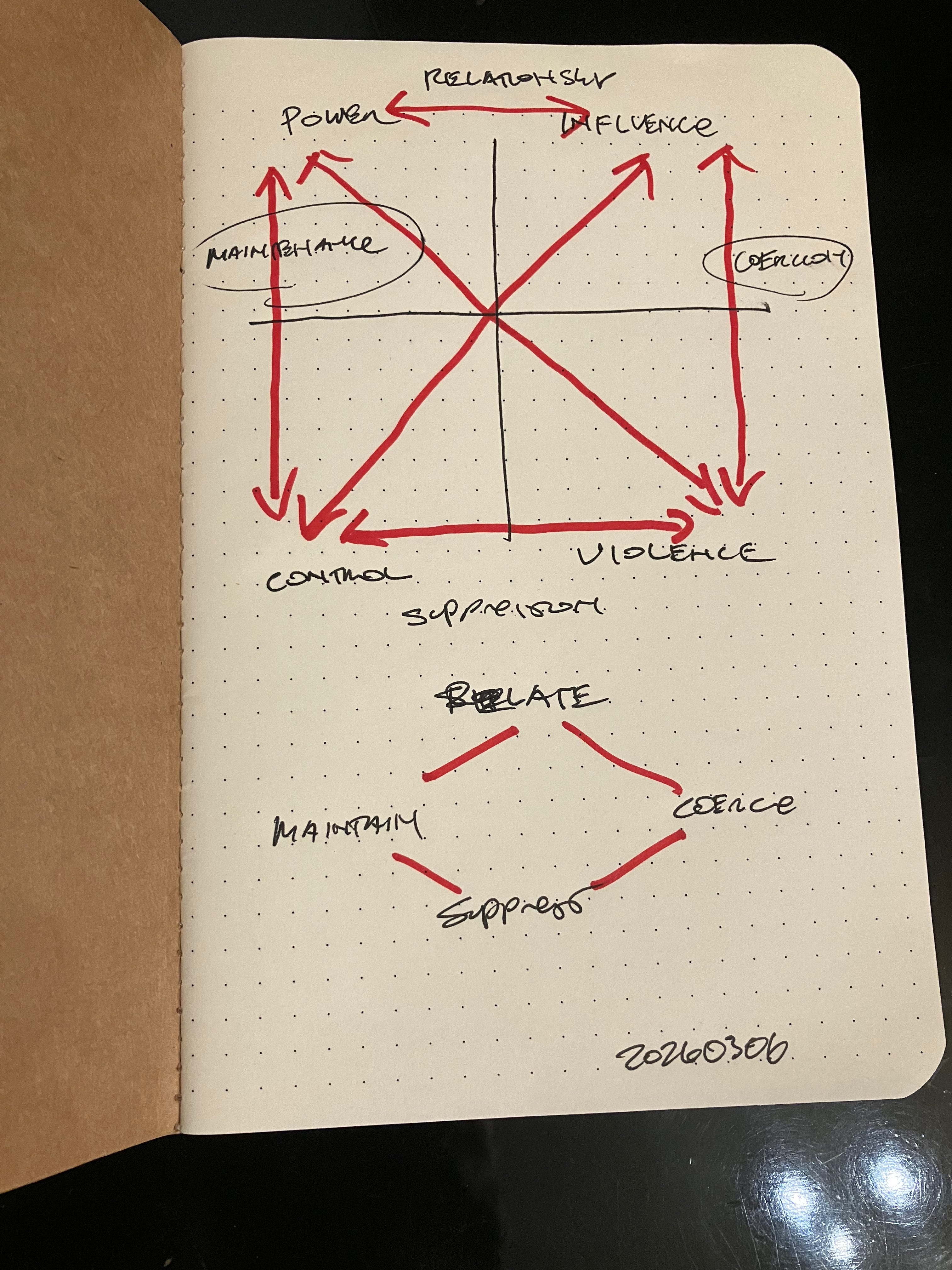
Okay. So what am I doing here?
Well, I was in a room with a great bunch of people, and we were talking about “power” and “influence,” but we weren’t making the connection that a lot of what gets called “power” in our culture is actually a euphemism for *violence.*
I sit in a lot of rooms where violence is present in the equation, but unacknowledged/unnamed. I wrote an essay about this, as well, a few months back.
The work I do draws on the thinking of Hannah Arendt, who wrote a book in which she asserted that “violence and power are opposites. Violence can destroy power, it can never create it.”
I take that seriously, and I try to think through the implications whenever possible.
So I pulled out my notebook and started sketching. I like quadrilaterals because they allow you to see tensions. You put one concept (“power”) in one corner, and you put another concept (“violence”) in the diagonal, and suddenly you have this tension between them.
But you also have questions. What goes in the other two corners?
In this case, I tried out “influence” and “control” as the opposite tension. That raises new questions.
Once you have the basic tensions in place, suddenly you have other interactions around the edges. What is the difference between powerful influence (where you have people working in solidarity) and violent influence (where a few are using exclusion and premature death as their tool)? Suddenly I see that one is based in relationship, and the other is based in coercion. So those go in the edges.
The best moment was when I realized that a mixture of “power” (which, again, is people working in solidarity) and “control” (which, like influence, I am thinking of here more like a tool, so a neutral term) leads naturally to maintenance, which is a concept my good friend Alec Badenoch introduced into my vocabulary a while back, and I am finally able to incorporate it somewhat.
That’s the best part: I started off with a rough tension, but in visualizing it and mapping it out, I suddenly discovered a whole lot more to think about.
So let’s clean this diagram up a bit.
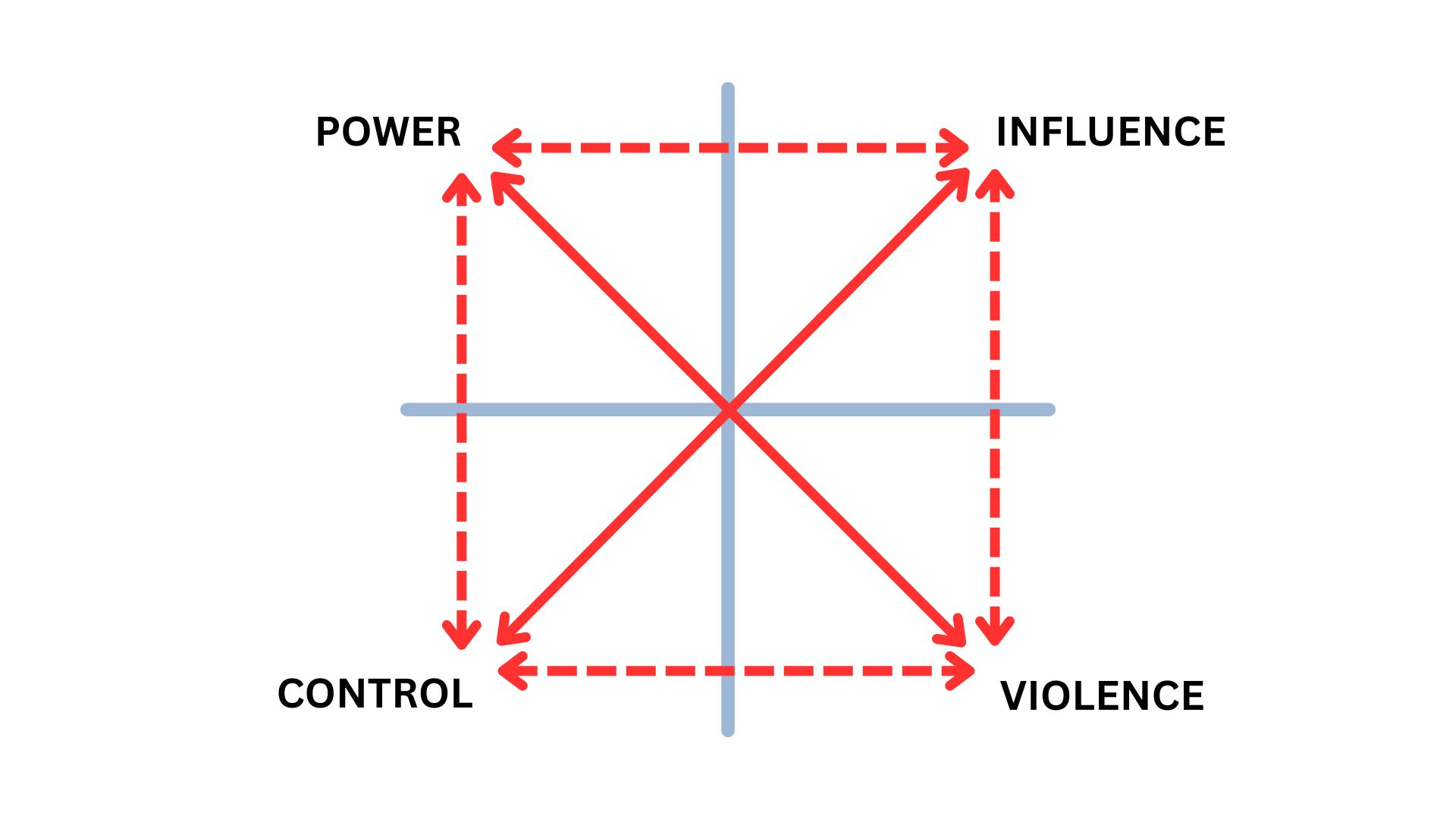
POWER - This often gets mistaken as being on a continuum with violence, with violence being but an extreme form of power. I am thinking of power in a much more precise way. Like Patti Smith said back in the day, “people have the power.” Power is people working together in solidarity to build towards unknown futures that aim at abundant life. Following Arendt, power cannot be held by one person - power only appears in community.
VIOLENCE - Following the thought of Ruth Wilson Gilmore, violence is organized abandonment that aims at premature death. You can see, then, how in this construal, “power and violence are opposites” (to quote Arendt again). Where power includes, violence excludes. Where power builds, violence destroys. Where power is based on trust, violence destroys trust. Hence, on the quadrilateral, the primary tension I started with is between power and violence.
INFLUENCE and CONTROL - As I began to think about the oppsite set of tensions, I played with a polarity of “influence” and “control.” I realize these terms are ambiguous, so in this case, I am thinking in a similar fashion to power/violence above. Influence is not a form or control, or vice versa. Rather, in this articulation, influence and control are opposites. Where influence is present, there is still agency, whereas when control is present, I have taken over the agency or the operation of something. That isn’t always bad - When I am driving a car, I don’t want to influence it, I want it to be under my control.
Once you have the basic parts of the quadrilateral in place, you can start to interrogate it. The main tensions are in the diagonals across the quadrilateral. After you have mapped those, you can look at the secondary tensions. In particular, you can explore what happens in the horizontal and vertical relations, like so:
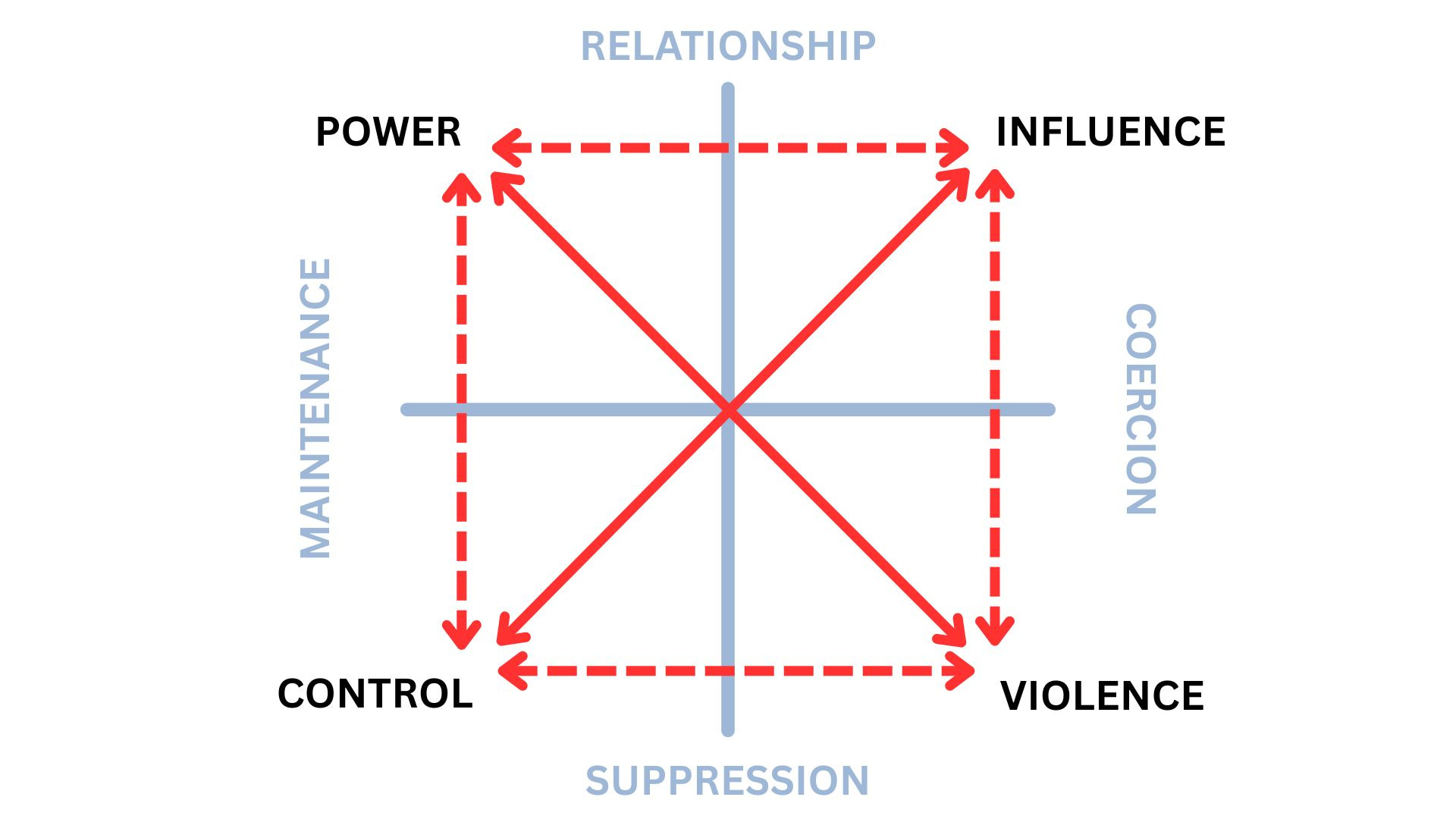
POWER and INFLUENCE manifest in RELATIONSHIP - Here, the collective action of many individuals exists in dynamic tension with the agency of each individual. The collective is in relationship with each participant, and each participant sees themselves in relationship to the collective. Neither assumes the other into violence.
POWER and CONTROL manifest as MAINTENANCE - Again, this is picking up on the ideas talked about by Shannon Mattern in the essay, “Maintenance and Care.” Mattern makes a couple of points that should be highlighted here. First, “infrastructure is personal.” That is (following similar insights made by Pope Francis in Laudato Si’) we cannot divorce or divest ourselves from the integral ecology that surrounds us. Humans are not separate from the world, but are intimately tied up in the fate of all living (and nonliving) things on the planet. Second, Mattern notes that “(1) Maintainers require care; (2) caregiving requires maintenance; and (3) the distinctions between these practices are shaped by race, gender, class, and other political, economic, and cultural forces.” This is where the control connects intimately to power - because the practice of power must account for all of these varieties of identity and experience. Power connects to the lived experience of each person.
VIOLENCE and INFLUENCE manifest as COERCION - Here, coercion if the opposite of maintenance. Coercion erases the particulars, and seeks to impose outcomes on the lived needs and experiences of each individual person. In this construal, a shoddy cosmetic “repair” to a damaged system is a form of coercion, as it seeks to create a false impression and a deceptive trust in the minds of those who need to use the ill-repaired mechanism or thing. We also can see that the direct use of force to constrain agency and limit outcomes are very visible forms of coercion. Coercion destroys relationships.
VIOLENCE and CONTROL manifest as SUPPRESSION - Here suppression erupts in two directions. First, I an thinking of all fascist arrangements, which seek to suppress the truth for their own preferred version of reality. The second is the continued attempts to suppress agency in all its forms, and instead to take over the thinking and decision-making of the populace.
Finally, as we continue the mapping, we can take away the primary quadrilateral, and explore the secondary relations in more detail:
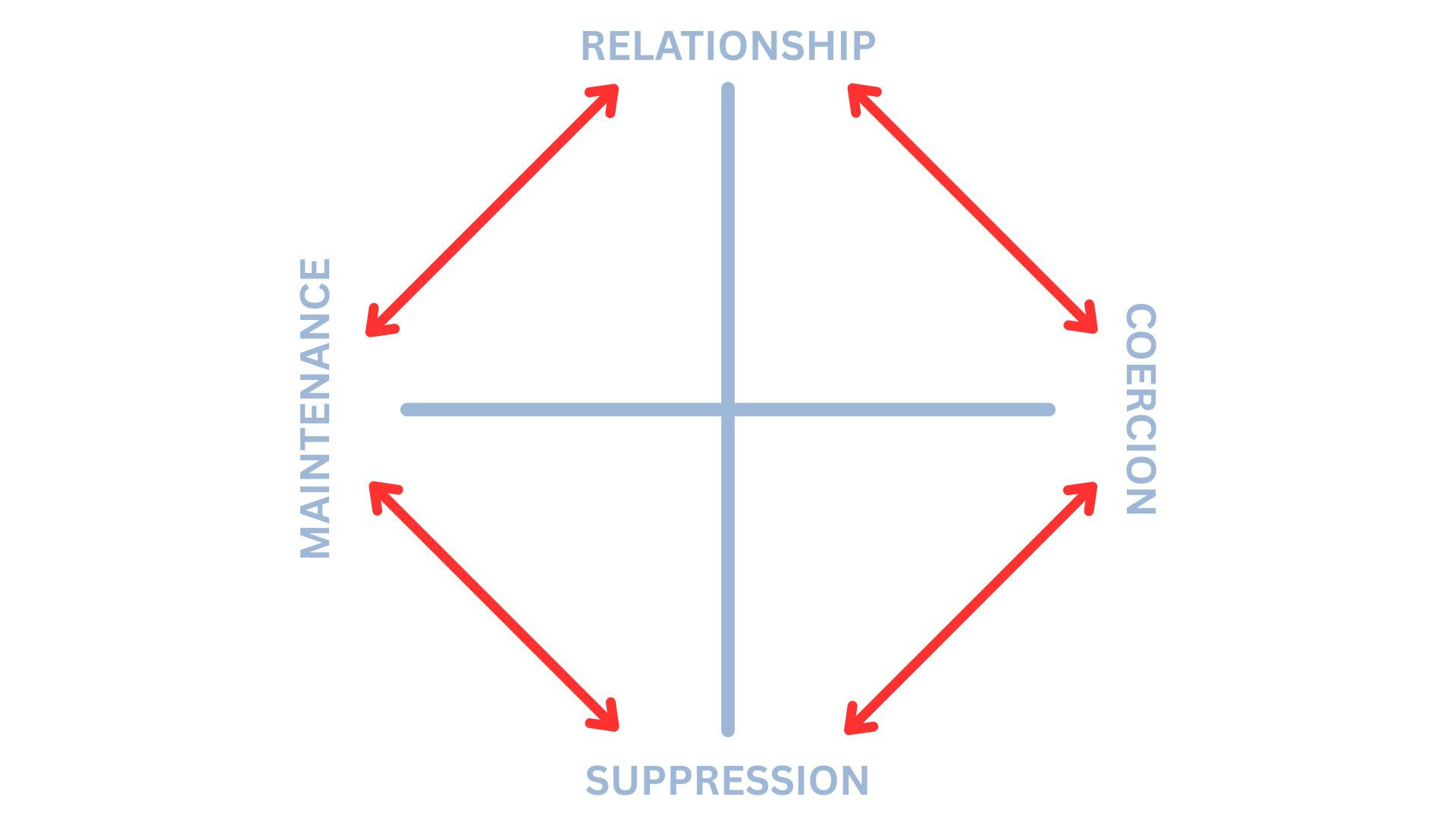
I’m still figuring out the implications of these secondary interactions.
As with all of these diagrams, the wording and the tensions are somewhat experimental and fluid at first. They have to be. This is very much my “first draft” of this new quadrilateral. As I continue to explore and refine it, I would love to hear your feedback and thoughts. What am I not seeing (yet)? What further connections and possibilities could be put into these interrelations? I welcome all your suggestions!
Map your ideas, beloveds. Sketch them. Cartoon them. Put half of it on the page, and let the page lead you to the other half.
Learn. Grow. Revolt. Find ways to save each other that violence hasn’t thought of killing yet.
Courage.