
Reproduction without natality
The logic of total control is vulnerable to surprise


1.
One of the books that has had the greatest impact on my thinking in the past decade has been Natality: Toward a Philosophy of Birth, by my friend and colleague, Jennifer Banks.
I’ve always especially liked the subtitle of the book. Toward a philosophy of birth. In keeping with the spirit of the subject matter, Banks characterizes her work as an invitation to further thought, rather than as a finished project.
Natality is a word that is simultaneously current and alien in our public discourse. We hear about tech bros like Elon Musk despairing of declining (white) birth rates, and his views are often described as natalist. Others like him, who center their relationships and lifestyle on having numerous children, sometimes are given the descriptor pro-natalists.
Yet at the same time, as Banks notes, we have not really given adequate space, as a culture, to thinking about all the implications of conception, gestation, birth, and natality. That is, when we think about natality, we tend to think about a rather mechanical process, as if mothers were more like factories than flesh-and-blood creatures, with contradictions and messiness and desires of their own.
A philosophical natalism begins by staking our the ground of what it is not. Much of western philosophy has taken the opposite path, that of fatalism. That is to say, philosophers have preoccupied themselves with how one might live a life that would arrive at a good death, a tidy completion of earthly affairs to be approached with calm and stoic resolve.
Fatal philosophies are also preoccupied with teleologies. That is to say, we are encouraged to think about change only insofar as that change will result in predictable ends. Fatal philosophies are all about the minimization of surprise. The only important aspect of the interaction is the conclusion. An acorn isn’t fully realized unless it grows into the tall oak tree.
The problem, again, is that, in our current culture, we reflexively think of teleologies as mechanical. Fatalism is fatalistic about the ends it proposes. An acorn can only grow into a oak tree, not a corn stalk. Fatalism, under this view, negates agency.
By contrast, natality affirms agency. Building on the thinking of Hannah Arendt and others, Banks emphasizes that the goal of natality is to “pry loose the rich and the strange” that arises from our interactions. When you and I gather together, as a pair or with others, there is the constant possibility of surprise. Something new and unexpected might arise from our interactions—something that cannot be predicted.
A system that is based on expected outcomes would see this as a flaw, or an error to be corrected. That is the logic of fatalism. But the logic of natality celebrates this unknown-ness about the future. Instead of seeing it as something to be expunged, the surprise is welcomed and celebrated. As Banks notes, “Birth can never undo death or forestall its advance, but wrestling with our natality can keep us connected to our source: the miraculous fields of life” (Banks, Natality, 207).
2.
Back in 1970, Louis Althusser wrote a short essay called “Ideology and Ideological State Apparatuses.” It is a powerful reflection on the manner in which capitalism relates to time. In the essay, Althusser observes that, “The ultimate condition of production is therefore the reproduction of the conditions of production. This may be ‘simple’ (reproducing exactly the previous conditions of production) or ‘on an extended scale’ (expanding them).”
Production is reproduction. When you think it through, this makes sense. If we have a factory, with machines on the assembly line, these machines are constantly having parts that wear out, and are in constant need of maintenance and repair. If the conditions of production were not continually reproduced, production itself would quickly come to an end.
In a more abstract sense, we do not simply reproduce the mechanical aspects of production. Althusser notes that we are also constantly reproducing the social relations that make production possible to continue. My boss yesterday may not be my boss tomorrow, but I will still be economically situated in my relations as an employee who requires a boss. For those relations to change, a great many material aspects of my life would have to change. Until those conditions do change, I willingly play my part in the reproduction of capitalism, because if I don’t, my family will probably starve.
The key aspect of this reproduction, however, is that it must reproduce the present into the future largely unchanged. The capitalist boss who benefits from exploiting my labor (and yours) has a great vested interest in making sure that five years from now our roles have not reversed. I may have a desire to move into a life of less labor, greater leisure, and increased agency. Such an outcome, however, while desirable to me, is undesirable to others in these social relations. For those who want predictable futures, the reproduction of relations as they are now becomes paramount.
The great enemy of stability is surprise.
3.
In his book, Capitalist Realism, Mark Fisher suggested that somewhere in the late 20th century we all got trapped in a fatal (rather than natal) set of social arrangements (which he called “capitalist realism”) where we are constantly reproducing the past into the present, but can never imagine anything new or changing. There is, in a very practical sense, “no future.”
(My friend Burke Gerstenschlager meditates on the implications of “no future” here.)
As Fisher put it,
“The slow cancellation of the future has been accompanied by a deflation of expectations. There can be few who believe that in the coming year a record as great as, say, the Stooges’ Funhouse or Sly Stone’s There’s A Riot Goin’ On will be released. Still less do we expect the kind of ruptures brought about by The Beatles or disco. The feeling of belatedness, of living after the gold rush, is as omnipresent as it is disavowed. Compare the fallow terrain of the current moment with the fecundity of previous periods and you will quickly be accused of ‘nostalgia’. But the reliance of current artists on styles that were established long ago suggests that the current moment is in the grip of a formal nostalgia … Yet, perhaps because of all this, there’s an increasing sense that culture has lost the ability to grasp and articulate the present. Or it could be that, in one very important sense, there is no present to grasp and articulate anymore.”
- Mark Fisher, Ghosts of My Life
This idea of the cancelation of the future does not mean that time stops. Rather, and more horribly, we continue to move forward in time, but nothing new is ever allowed to occur again. As Radiohead once put it, “everything is in its right place,” meaning that it is known, quantified, predictable, and above all controllable.
The goal of capitalist realism, then, is reproduction without natality.
4.
The Lion King is a Disney media franchise comprising a film series and additional media. The success of animated original 1994 American feature film, The Lion King, directed by Roger Allers and Rob Minkoff, led to a direct-to-video sequel and prequel, a photorealistically animated remake in 2019, a 2024 prequel/sequel to the 2019 film, a television film sequel, two spin-off television series, three educational shorts, several video games, merchandise, and the third-longest-running musical in Broadway history, which garnered six Tony Awards including Best Musical. The franchise is one of the highest-grossing media franchises of all time.
- from Wikipedia
When we explore reproduction without natality, one of the most visible sites of the phenomenon is the current state of media production. As Mark Fisher predicted, we seem in many ways to have lost both our imagination and our appetite for new stories. Instead, as with the example of The Lion King above, we find ourselves trapped in a cultural hall of mirrors, telling and retelling the old beloved story again and again, in increasingly outlandish forms of media.
In the case of The Lion King, the original animated film’s success first invited sequels (and sequels-that-were-prequels). Then, the story was re-made into a live performance format, becoming a hugely successful Broadway and touring show. In all these cases, the story was reskinned, repackaged, into new formats that were designed to create as many possible points of revenue from the original intellectual property.
Then, however, the (re)production of The Lion King reached a kind of nostalgia overdrive. In the hands of director Jon Favreau, the intellectual property was (re)produced yet again, but this time not in an animated form, or in the realm of theatrical suspension-of-disbelief and wonder. Rather, the animated film was re-created, basically shot-for-shot, but now in a motion-capture format. That is, the characters that had been presented as animals in the style of traditional animation were now (re)presented and (re)produced as-if they were actual live animals from the wild, only with anthropomorphic expressions and the power of speech.
Fisher’s observation here is that our technology that we use to mine the ideas of the past gets constantly better and better (traditional animation cells now replaced by advanced CGI and motion capture). However, at the same time, we are not allowed to have new ideas. The only stories that seem to get made with this level of production and backing are the ones that have already been established as “hits,” and therefore are guaranteed to create a good return on investment.
To bank on a new idea would be to risk an unpredictable outcome, and the great enemy of stability is surprise. We want no surprises, only profits.
That is, we want reproduction without natality.
5.
Not just in art, of course, but in the realms of policy, as well.
I don’t need to dig too hard to find examples of a violent return to old and outmoded ideas that are now being (re)produced in the public sphere.
Take, as but one example, the recent barrage of memes posted by the US Department of Labor under the current Trump administration.
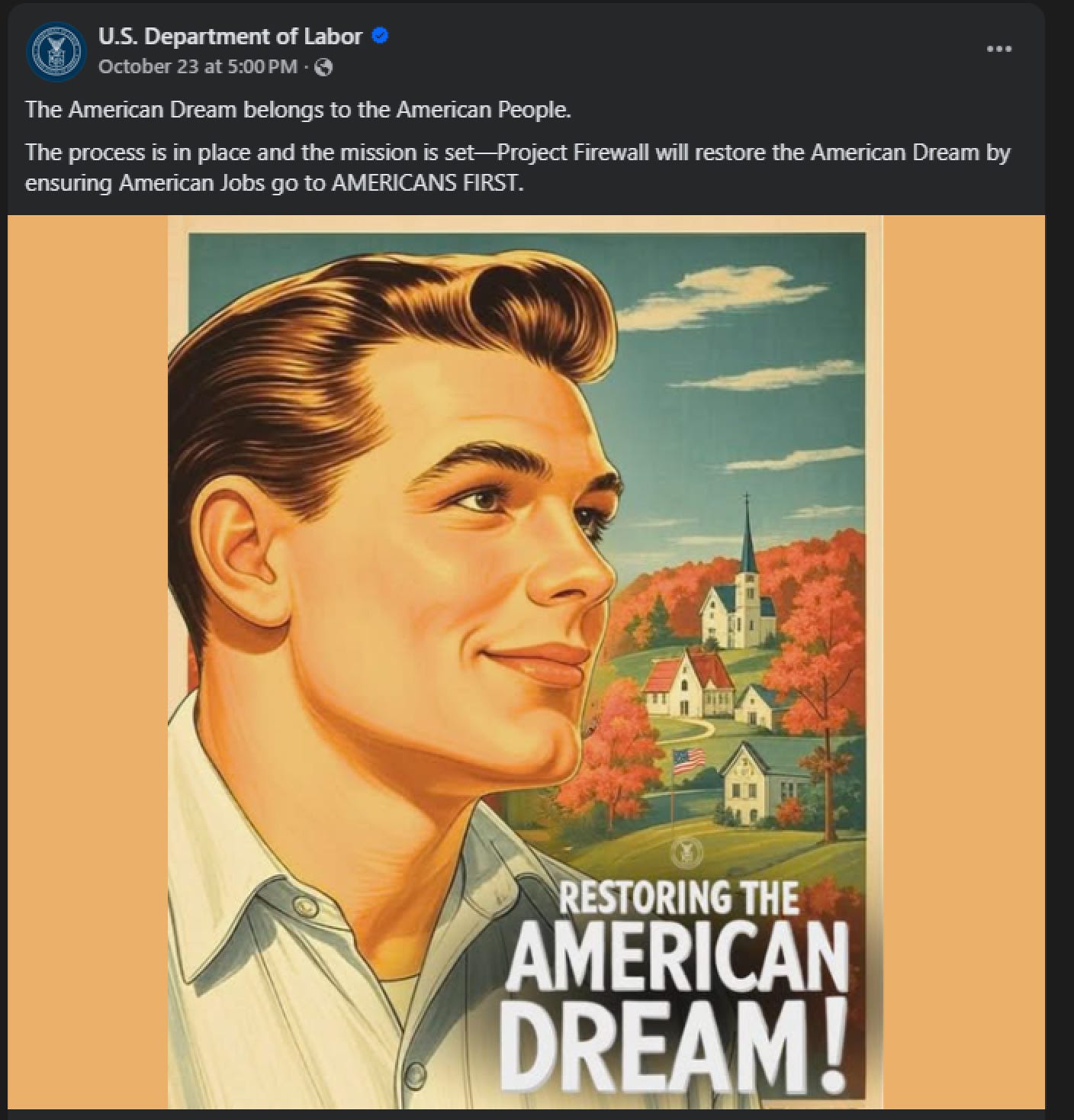
The images are clearly generated using various forms of “artificial intelligence” algorithms currently en vogue. The images themselves, however, are (re)presenting an idealized and mythologized (white, patriarchal) past that sort of existed in the 1950s here in America.
Of course, what also existed alongside this idealized and nostalgic past was a lot of racism, sexism, economic deprivation, and policed gender conformity. None of these are good ideas—then or now—and yet they are being (re)presented as-if they are novel and untested solutions to our current cultural malaise.
They’s not. Nevertheless, these mems are just the tip of the policy iceberg, as sectors of our government now seem hell-bent on running backwards as fast as possible to a time without vaccinations, social supports, or equality of opportunity. Like the zeal to mine the intellectual property of The Lion King using ever-more freakish technologies, we see elected leaders and unelected coercion-brokers in our government seeking to mine the nostalgia for an imagined past to create a modern and well-oiled torture state in the present.
Again, the goal is a world with no change and no surprises for those who stand to make the most profits. A world without surprises. A world, in short, without natality.
6.
And yet, to produce the sort of world they seek, those who stand to make the most profits from coercion and control are reliant on reproduction.
We see this, of course, in their obsession over birth rates (at least, the birth rates of certain populations). The result of this obsession, perversely, is a natalism without natality. That is, they want “children,” but only in the sense that they desire objects that can be easily manipulated and perpetually controlled.
The idea that a child might eventually choose a different path than the mapped-out path is seen as a great catastrophe, instead of being what kids are supposed to do. We need look no further than Vivian Jenna Wilson, the eldest daughter among Elon Musk’s fourteen children.
Wilson, who is trans*, has reported that her father has declared repeatedly that she is “not a girl” and that she is “figuratively dead.” Wilson goes on to recall that, “when she was a child, Musk would harass her for exhibiting feminine traits and pressure her to appear more masculine, including by pushing her to deepen her voice as early as elementary school.”
Returning to the idea of natality, we can see two roads possible in any human relation. The first road suggests that the person before us is a mystery, and as they slowly reveal themselves to us in relationship, we are open to the delight of surprise. Each interaction brings a new possibility to engage with some aspect of the person that we did not know before, and in this manner the relationship stays fresh, renewed, and alive. Such a relationship has a future in the most fundamental sense, in that it is not a mere (re)production of the known present, again and again.
The other road suggests that the person before us is a product, an object for consumption, or a form of our intellectual property. Instead of being the protagonists of their own story, we imagine them to be minor or non-player characters in our story. The value they would hold for us, then, consists in “playing their part” in the scripts that are already written and that cannot be changed. The is the coercive imposition of a teleology on the other person: you must be that I have declared you to be. Such a relationship has no future in the most fundamental sense. It is only comfortable as a relationship if one side (the child, the employee, the vulnerable or economically precarious side) is fully beholden to the whims and desires of the parent, the boss, the one with the access to the violence.
Elon Musk is a highly visible example of the second road taken, but he is by no means alone. We can currently see much of our public policy being re-engineered toward a regime whose entire logic is reproduction without natality. We can observe all levels of the state being turned toward an expectation that our bodies are only welcome in public insofar as they can be utilized for production or reproduction of the status quo. The idea that we would imagine or act in unpredictable ways, bringing about new or unexpected aspects of our social relations is treated as a threat, perhaps even a threat to the state itself (to the extent that things are now being vaguely characterized as terrorism).
But surprise and unpredictability are what make sustained life possible.
7.
Banks concludes her book by saying,
Life is under threat in the twenty-first century. Even as life expectancies have risen dramatically over the last few centuries, we still live close to death. But birth is constantly here with us, too. Birth can never undo death or forestall its advance, but wrestling with our natality can keep us connected to the source: the miraculous fields of life. Birth can help us see our lives as a “mark of resistance,” as Adrienne Rich called it, to the floods that will soon arrive” (207).
The floods are here, and much sooner than we might have wished. We can keep pretending that we are safe, but we are not. We are in the zone of risk already, and any hope that we might have had in reproducing the present that got us here is unsustainable. The only hope we have now is in the unknown future, the one that is beyond our current collective imagining.
The fatal future is the mark of our death-drive, our desire to finally have everything, everything, under control. But that urge to control has brought us, individually and collectively, to the brink of death. There is another way.
The natal future cannot be marketed or monetized. It is not available for sequels and prequels. This aspect makes it terrifying for a certain way of thinking, a way of thinking that wants every child quiet, docile, and controlled. Our hope now, our only hope, is in the unruly children. Oour only hope is in the relationships that surprise us. Our only hope is in a complete failure to reproduce what has been, and to witness the birth, at long last, of something truly new.
This piece is . . . remarkable, in every sense of the word. I'm thinking now of all the institutions that struggle to maintain reproduction without natality, without surprise. Is the "secularization" of society - an evil if you listen to conservative homilists - a subconscious response to the entrapment by the institutional Church of its members in this ongoing process of reproduction without natality, without change? A process that is ultimately ineffectual in meeting the needs of the times, and in denial of historical fact and scientific truth?