
Artificial Intelligence in an Ignatian context
Reflecting on "deep learning" though a Jesuit lens

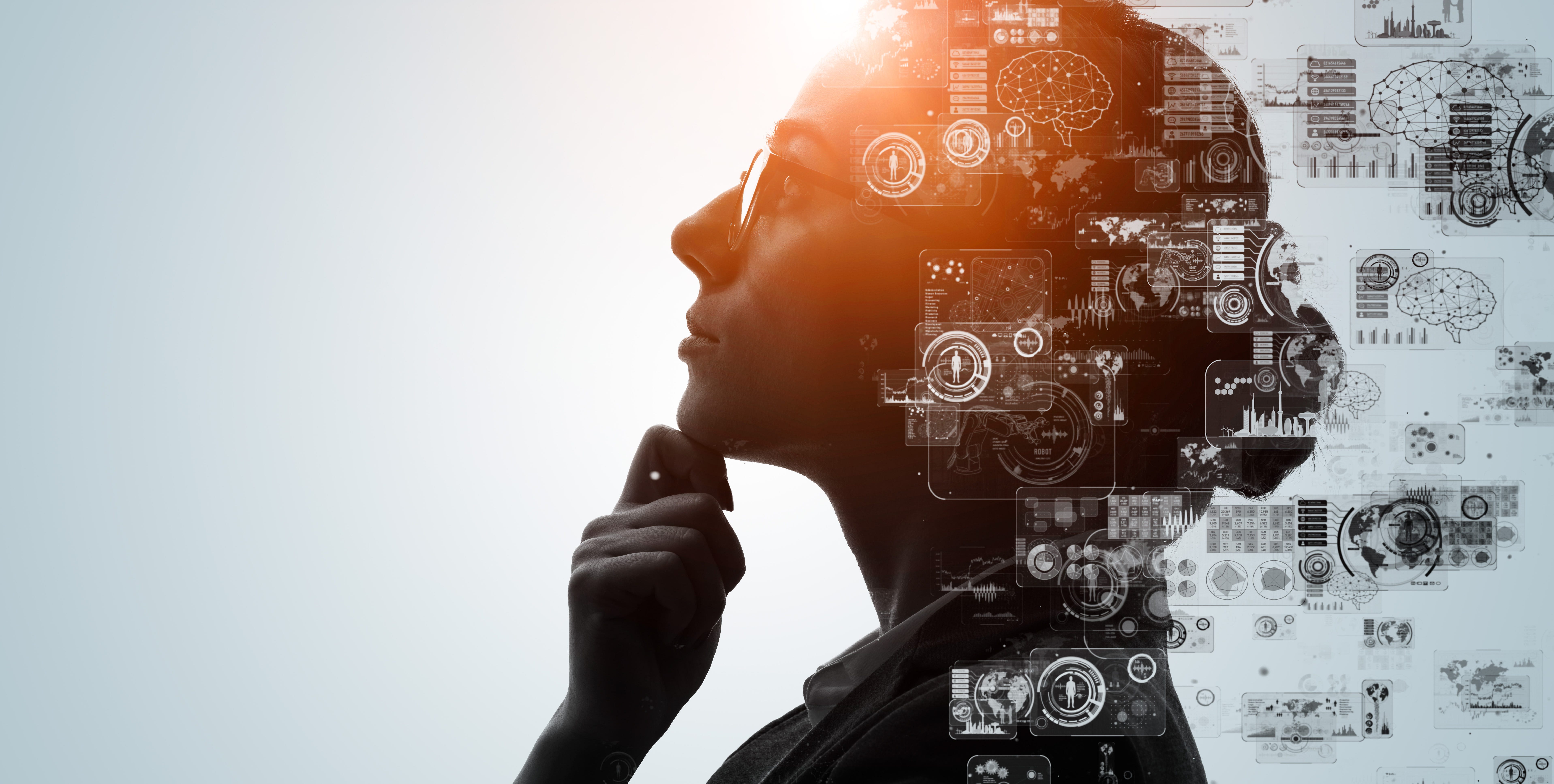
I wrote this up to include in my syllabi for my courses this coming spring. I figured it would be good to get feedback about it, so I welcome your thoughts and comments. Thank you.
I am legally blind. This means that, left to my “natural” state, I would find it very hard to function in our current society. This is because our society is largely designed and built for those with well-functioning sight. If my eyes were slightly worse, I would require alternative means of transportation, written communication, and navigation. The “abled” world would have left me behind in my childhood, and I wuold have been left in that abandonment to forge my own, idiosyncratic path into work, affection, and community.
However, thanks to a technology (one that is relatively complex, but delivered in a relatively simple way to me), a technology based on physics and optics and many centuries of improvements in lens crafting, I am able to strap some pieces of plastic to my face. Suddenly my visual impairments are brought back into the “typical” range. The difference between my un-aided and aided vision feels nothing short of miraculous.
I am also a recovering addict. Now, make no mistake: the first few times I used various substances, it felt similar to how it feels when I put on my glasses. The fuzzy landscape became more clear, and it felt more possible to navigate a dangerous and myopic world. Chemical and medical technologies are their own sort of “miraculous,” in this way. Swallowing a drink, or swallowing a pill, and I was able to move beyond pain, anxiety, and all manner of fear. What was not to love?
Yet over time, the quality of these experiences diverged. My eyeglasses have needed frequent cleaning and regular updates and replacement. Even with these inconveniences, however, the net effect of glasses on my life has been consistently positive. In contrast, as I continued to use various substances, I observed that my fundamental relationships (to others, and also to myself) were undergoing severe and damaging changes. Nevertheless, for longer than I am happy to admit, the thought of navigating daily life without my substances felt as alien and potentially harmful as the thought of trying to navigate daily life without my eyeglasses.
Our shared cultural space does not make it easy to discern the proper paths to take. For example, some folks who experience chronic illnesses or forms of disability may feel that they are discouraged (explicitly or implicitly) from accessing technologies that make their lives more livable and their pains and debilitations more manageable. They may get the message that the “moral” or “healthy” way to approach their situation is to “tough it out.”
At the same time, we are surrounded by multiple billion-dollar industries, whose business models are predicated on offering efficiencies, shortcuts, and quick fixes to our problems, whether real or manufactured. And thus a person might reasonably ask, “Why take the time to memorize multiplication tables when I have ready access to a calculator?” or “Why bother to learn that piece of information when I can just Google it when I need it?”
In our present culture, these sorts of questions are often indistinguishable from questions like, “Why shouldn’t I wear my eyeglasses if they help me to see?” or “Why shouldn’t I swallow this pill if it helps me feel less anxious?” We might imagine that there are bright lines in these cases, and that it will always be very clear when we are faced with a question whose natural answer is “Yes, do it, this is good,” and a question whose natural answer is “No, don’t do it, this is bad.” In practice, however, we know that such questions very rarely arrive with such neon clarity, if at all.
My eyeglasses have been a positive good in my life. As much as they have helped me to see, in all the years I have used them I have never felt that they began to do the seeing for me. For a season, the various substances I used were also a positive good in my life. Over time, however, I experienced a shift. In my experience, the substances I was using went from helping me to feel more fully and boldly, to (for want of a better way to phrase it) to a place where they started to drive my feelings, almost as if they were doing the feeling for me.
I recognize that not everyone’s experiences will be similar to mine, and I offer them here, not to generate a universal case or lay down a bright line, but to illustrate that I understand that these questions are complex, deeply personal, and that our answers to “the right thing to do” in various cases might shift over time. I have never felt the need to put down my eyeglasses, or to risk living without them. I did reach a point with substances, however, where it was important to me to take that risk, and to see what life would be like without them.
We are now at a point where a fascinating new set of technologies has become available to us. It is quite new, and the conveniences and efficiencies we are promised by this new set of technologies seem almost unparalleled in human history. I am referring to technologies that are loosely grouped around descriptors like “Large Language Models,” “Machine Learning,” “Deep Learning,” and “Generative Artificial Intelligence.” They are driven by algorithmic logics, and the developments are unfolding rapidly.
I am hesitant to offer a list of examples, in part because there would be no way for that list to be comprehensive. This is especially true because many older and more stable technologies are being alloyed with these new variables, yielding outcomes and new combinations that are hard to categorize with precision.
These new technologies and combinations are being marketed to us with a great deal of promise, bordering on hyperbole (or simply hype). We are told these new technologies will quickly yield revolutionary breakthroughs in healthcare, scientific research, and education. What the actual results will be remains to be seen.
For some of us, using these technologies will feel very much like putting on a pair of eyeglasses, in that the world becomes more clear and we feel emboldened in our navigations of the landscape. In other cases, these technologies will function more like numbing or stimulating chemicals, in that they will take us father away from a clear apprehension of the world.
I am not here to dictate to you how to engage with these new technologies. I am not sure folks would pay much heed if I did. The possibilities are too exciting, too enticing, indeed too tempting to avoid exploration. More likely, we are already navigating a landscape that has been affected by our access to LLMs and GAIs.
In my work as a professor at a Jesuit university, I teach students and engage with scholars in an Ignatian context. Drawing on the work of Ignatius Loyola and his Spiritual Exercises, I encourage encourage everyone I work with to pay special attention to the question of inner freedom with regard to our use of these technologies. That is, as we interact with the various portals and avatars of “Generative Artificial Intelligence,” we can pay attention to how these encounters affect our emotions, thoughts, and desires. We can become ever more aware of how the choices we make are helping us to feel more connected to God’s will. Alternately, upon regular reflection, we may find ourselves increasingly distracted by unhealthy attachments.
Over time, as we interact with LLMs and GAI portals, we might ask: Are we feeling more connected to the community of shared learning around us, or more estranged? When we ask a question, and it comes back instantly answered, does this result draw us more fully into the depths of knowledge, or tug us back to the surface of things? If a platform takes over our writing for us, does that make us feel more or less confident over time?
There is not a “one size fits all” answer to these questions, and our own experiences my well change over time. When I teach, I invite every participant my courses to engage in sincere and morally serious reflection around these matters throughout their studies.
Above all, I encourage each of us—those I teach, those I work with, and those reading this essay—to pay attention to how we move in the world as whole persons. We may become aware of this on our own, as we utilize Ignatian tools and practices such as the daily examen. We may also become aware of this as we interact with others. That is, our development over time will also become particularly clear as we have opportunities to interact with others around us in their own whole personhood. In all regards, we can explore if our actions and interactions over time draw us closer to that friendship and freedom promised to us by Christ.
Our eyeglasses help us see, but do not take over the seeing for us. Let us be cautious of those tempting moments when some other entity, whether natural or artificial, steps in and offers to do some part of our thinking or our feeling for us. Such arrangements can feel wonderfully liberating at first, but the shadow of addiction always lingers in the wings.
So I invite you, with prayer and thanksgiving, to explore all the opportunities and gifts offered to us by various methodologies and technologies. I also urge you to take regular and adequate time to pause and reflect upon the effects these interactions have on your heart, your mind, and your soul. As we proceed, I hope you will feel comfortable bringing these reflections into conversations, with me and with others who are about your growth and wellbeing.
In all we do, may God be ever and ever more glorified.