
A question for David Dark
An inquiry into Peter Gabriel's "Lay Your hands on Me" and the "God Grift"

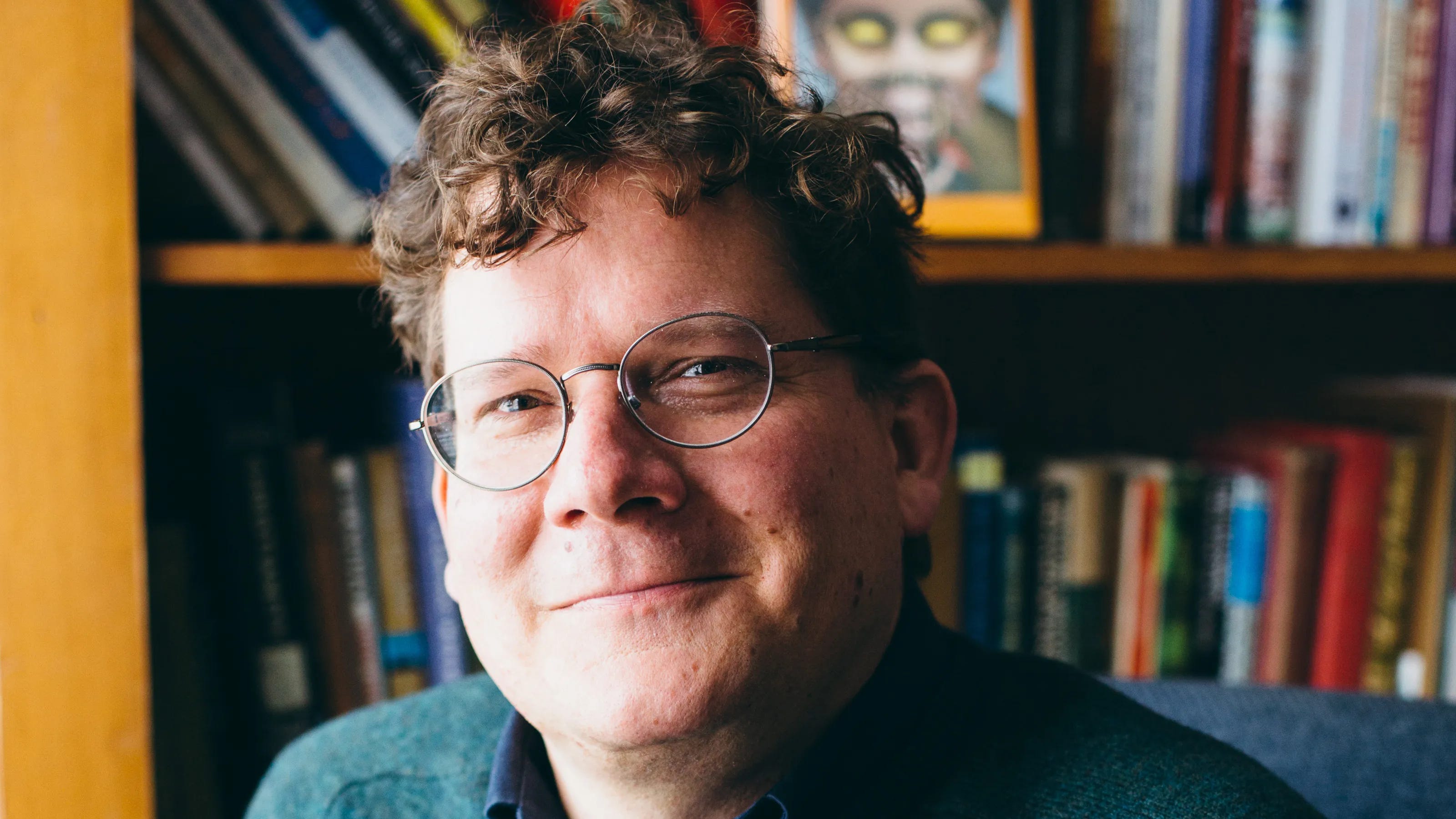
Folks who have been following me for a while will have noted that I hold the ideas and writings of my friend David Dark in high esteem. If you don’t know him, you should. He is a professor of religion and arts at Belmont University, and is a prolific author.
His relentless presence on social media helped to attenuate me to the situation around Reality Winner back in the day. He was also an early voice pointing me toward the thinking of Hannah Arendt. Further, in my recent book The Accessorized Bible, I devote an entire chapter to trying to deepen my understanding of what Dark has often described as “baseline moral seriousness.”
So imagine my delight and surprise to discover that Professor Dark has launched a new YouTube channel, The David Dark Situation. The impetus seems to come from a line spoken by M. Gessen, referring to the way that authoritarian regimes operate. As Dark recounts it, Gessen suggests that such regimes do their best to evacuate the space of culture, and thus it becomes important to those of us who wish to resist this evacuation to work to fill what has been emptied. As I understand Professor Dark’s intentions, his Situation efforts are one such method for raging against the dying of the light.
So far, nothing in the Situation is particularly new. If you know Professor Dark’s work and style, this will all seem very familiar. He is looking at popular culture (for example, a long distraction with the Guns ‘n’ Roses song “Sweet Child o’ Mine,” which spans multiple episodes) and using this pop culture as a lens to look at political and religious culture. There is also a rehearsal of some of Professor Dark’s “greatest hits,” such as taking up the idea of how culture relates to the idea of “cult” and mass practices.
None if this is meant as a criticism. I think it is a factor of Professor Dark laying a groundwork of ideas for potentially new audiences. For while the ideas are not new in these early episodes, the medium certainly is. With the Situation, Professor Dark is stepping away from his usual zones of comfort (writing—both in long form and on social media—and live events) into a zone of risk (short form video essays). To get new eyes to follow with him, he seems to be marking out the territory they will encounter along the way. For those familiar with Dark’s work, as well as for new audiences, both, I think this is a useful exercise—at least here at the outset of the project.
I have taken particular interest in the fourth episode of the Situation, which as of this writing is also the most recent episode (although he seems to be on a roughly one-episode-per-day release schedule, so by the time you read this, that likely will have changed). In this episode, Professor Dark takes up two of his core ideas, that he has been developing in his printed work and in online provocations over the past few years. These ideas are his notions of the prayer trade, and the God grift.
As I understand it, the prayer trade is the expansive landscape of commercial culture, that exists around the various cults of belief that are specifically branded in our lands as religious. In the video, Professor Dark holds up a Jim Nabors album, where Nabords is signing various hymns and prayers, and identifies this as part of the prayer trade. However, he also calls out specifically the type of work that he and I both do, as educators employed by various religiously-affiliated schools, as being part of the prayer trade as well.
The concept of the prayer trade is not meant to be rigorous. It’s a big and fuzzy circle on purpose, because it allows for an analysis that works on the level of the Borg in Star Trek, or the Blob in the old sci-fi B-movies. That is, it is a concept designed to have a very sticky associative quality. If something feels like it is part of the prayer trade (even if it is not explicitly religious, such as a Superbowl halftime show) it probably is. As I see it, this is a strength of Dark’s analysis, not a weakness, though some might certainly disagree.
What I find especially useful about drawing the sticky circle of the prayer trade in this manner is that he and I both get caught up in the ethical implications of that inclusion. It is very unlikely that the prayer trade will remain neutral; it is easily pulled toward the interests of empire, and less easily pulled toward the interests of justice, mercy, and modesty (if we wish to take Micah 6:8 with a baseline level of moral seriousness). Caught up within this sticky circle, educators like Professor Dark and myself always run the risk of decaying into court theologians (to borrow a phrase from my dear departed friend Walter Brueggemann). We risk—either through buying in, or through a buyout—becoming mere apologists for empire.
We might think of the prayer trade as evangelical (in the best sense) and inclusionary (in the most hospitable sense). With the prayer trade, the mouth of the funnel is wide, and the desire is to bring as many folks as possible into the conversation. So, for example, our classrooms are not points of narrow indoctrination or wide exploration (I am speaking for myself, but I feel somewhat confident assuming the same about Professor Dark). We do not get to “weed out” who might be sitting in our courses. They will have varied and inscrutable backgrounds, and our pedagogies must accommodate that extraordinary variety.
That leads us to Professor Dark’s concept of the God grift. In the video, Dark describes this as the “circle within the circle.” In contrast to the flexible borders of the prayer trade, the God grift puts up patrols and fences. We might think of the God grift as apologetic (in that it argues for a “right way” the belong and believe) and exclusionary (in the least hospitable sense). With the God grift, narrow is the way, and strait the gate. The whole mechanism of the grift is about limiting access. Like the V.I.P. section of a club, the God grift sets up bouncers and baffles, gates and gatekeepers. You might catch a glimpse of the holy things, but they aren’t for the people, but for the privileged.
Throughout Professor Dark’s work, he has been interested in naming this mechanism where he finds it, and dismantling it where he can. As he puts it in his Revised and Expanded edition of Life’s Too Short to Pretend You’re Not Religious, “True religion knows no neat divisions. The more we divide, the less we see” (165). There are many, however, who profit early and often from such obscurities. Riffing on Phillip K. Dick, Dark observes that “Disinformation … is noise posing as significance” (99). The God grift is chiefly concerned with selling the noise as if it were the real thing: real community, real presence, real transcendence.
2.
I had all of this in mind this morning as I drank my coffee. The YouTube algorithm knows me well, and it brought up a suggestion that I watch this snippet from a concert by Peter Gabriel, recorded in Athens back in 1987. The clip is not even of a full song, but rather just the end point of “Lay Your Hands on Me.” The song was a staple of his shows from the mid-80s onward, as his fame and popularity were growing.
As you will see in the video, at the conclusion of the song, the band starts to repeat the refrain of the chorus—Lay your hands on me! Lay your hands on me!—over a syncopated and aggressive drum pattern. As this continues, Gabriel sets down his microphone and approaches the lip of the stage. Turning away from the audience, he raises his arms, and falls backwards into the crowd, which then carries him aloft for the next several minutes.
Eventually, after he has surfed the crowd to dozens of feet away from the stage, he turns over, allowing himself not only to be touched, but faced by those in the audience. In this moment, he is seemingly fully vulnerable, and fully willing to let whatever might happen, happen. Indeed, soon after this, we see that his outer garment, his white coat, is ripped off of him, and it looks for an instant like he might be stripped even more fully by the crowd.
Eventually, Gabriel nears the stage again, and one of the stage hands helps him back up to his feet. He has the microphone again now, and he begins to respond to the refrain that has been chanted for the last several minutes, crying out “Over me! Over me!” Interestingly, going all the way back to the first episode of The David Dark Situation, this is yet another example of a musician using a drawn-out phrase—in this case, the “me” of “Over me!”—to created a sustained emphasis through pitch-shifting.
What struck me, however, as I watched this clip, was the embodied response of Gabriel after his time in the crowd was done. As he returns to the stage, his energy seems both focused and electric. He appears to be elated. He beams with joy, he jumps and cavorts. He throws his energy back out to the crowd. Where he was physically connected with a few souls in the front, he now projects an aura of being fully connected to everyone in the stadium.
This is where synecdoche meets parasociality. The amount of actual physical contact was relatively small, when compared to the whole crowd, but it was palpable to everyone precisely because it was so raw and vulnerable. In his moments of being buoyed by the crowd, so much could have gone differently. So much could have gone badly. And yet, there was no disaster, no tragedy. Instead, Gabriel emerged from the other side triumphant as if a primal fear had been faced and bested.
It is important to understand that this was not a fluke or a one-off. From the earliest days of his solo tours after leaving Genesis, Gabriel had been conducting experiments in radical vulnerability. During his first tour in the late 1970s, he would begin each evening’s set at the back of the house, working his way through the crowd with a flashlight. By the mid-1980’s he was stepping off the stage into the crowd, even at larger venues. Finally, with the incorporation of “Lay Your hands on Me,” we see the full blossom of this performative vulnerability that is also, strangely, actual vulnerability.
In making these moves of connection and vulnerability, Gabriel forged a powerful bond with the audience, even at a great distance. It is something akin to “breaking the fourth wall,” but it is even deeper than that. Gabriel was not simply acknowledging that the audience was there, but was making his whole self available to the audience, for whatever might happen. The crowd surfing was an act of trust en masse, a leap without a net.
3.
Here’s what I am thinking. It strikes me that the prayer trade, as I understand it, is something akin to Gabriel’s availability to the crowd. It may be performative, it may have some guardrails and stage hands around to help with the transitions, but it is specifically characterized by vulnerability.
When Professor Dark and I enter our classrooms, we do not do so cloaked in any sort of magisterial armor. There is risk. We are entering a potentially illuminating or potentially hostile conversation, and there is no way of knowing in advance which it is going to be. As a result, like Gabriel, we may end the class sessions elated and radiant. More often, however, it might feel like we have just been stripped mostly bare, with no protections. In either case, we are involved in a two-way interaction. We are indeed at the mercy of that interaction—there is no other place to hide.
In contrast, here is how this makes me think differently about the God grift: Where the prayer trade is vulnerable and open-ended (at its best, mind you), the God grift seeks to be interpenetrated through and through with control. It reminds me of that old line from James P. Carse in his wonderful book, Finite and Infinite Games. In the God grift, the distance between folks might be reduced to zero, but nobody actually touches each other. There is no true vulnerability, no risk whatsoever. If the prayer trade is willing to make itself available to an open and unknown future, the God grift is engineered to provide only the known and predictable future.
4.
So this brings me to my question for Professor Dark: I think there is something significant in this observation that the prayer trade is characterized by openness and vulnerability, whereas the God grift is characterized by the control of access and minimizing all possible risks. Professor Dark, as I make these distinctions, do you agree, or is there something I have missed here?
Assuming I have been more or less on the mark, then some considerations might follow from this distinction. In particular, my suspicion is that when we have truly been available to the space of risk and vulnerability, we can feel that in our whole bodies. Much like Peter Gabriel’s reaction to his own moment of vulnerability, we are charged with excess energy that connects us, even to those at some distance, and that connection is palpable on both sides of the relationship. It may be performative, yes, but it is not exhausted by the performative.
In a similar manner, I believe we will feel it in our bodies when we give ourselves over to the spirit of the grift. I think there is a somatic closure that might result from that giving-over. This would be a closure, not only to other living beings, but also a closure to time itself. Vulnerability on all fronts becomes the enemy when the God grift takes hold. Instead of seeing companions on the journey, all life outside of the grifter becomes reduced to the status of sucker. Either a sucker in the P.T. Barnum sense (as in, these are the poor fools that I will soon part from their money), or suckers in the Ayn Rand sense (as in, these are the moochers and the leeches that I must keep from siphoning off my hard earned and deserved rewards). Either way, suspicion replaces solidarity.
So that’s it, Professor Dark and everyone listening. That’s what this new web series The David Dark Situation has me thinking about today. I hope this is useful, at least. Even more, I hope it generates some conversation. Thank you for your attention to this matter.